Climate change, global warming, IPCC, government, media, propaganda, deficit, inflation, earthquakes, volcanos,
pollution, ice ages, greenhouse gases, carbon dioxide, methane, water vapor, sea ice, Arctic, polar bears, seals, whales,
energy, temperature, cod, salmon, El Nino, hurricanes, typhoons, earth, freshwater, deforestation, physics, chemistry, biology,
freshwater, aquifers, desalination, disinfection, fluoridation, air, ozone, smog, acid rain, crude oil, coal, natural gas, electric power,
electric cars, fossil fuels, natural gas, nuclear, geothermal, heat pump, wave power, osmosis, wind, solar energy, biofuels, ethanol, engine,
hybrid, hydrogen, light, food, organic, genetically modified, fish, contaminants, sun, radiation, light, X-rays,
weather, droughts, floods, diseases, longevity, cancer, Alzheimer's, malaria, progress |
|
The Blog
On COVID-19 "Cases" vs. Deaths — Facts and Obfuscations; posted on Oct. 16, 2020
The COVID-19 problem is being being exaggerated out of proportion! - Nearly everywhere!
Lockdowns, mask-wearing, closures of restaurants, theaters, and other public venues, "social distancing rules" and other orders, all claimed
to be viral transmission prevention rules, are the new norm of reality, in many parts of the world.
Can you tell me what, exactly, is a "Case" and why it is relevant?
Initially, say February to April 2020, the ordered restrictions were to "flatten the curve," i.e. of hospital admissions for intensice care, etc.
But now, with many hospital wards nearly empty, nurses on furlough, and other potential patients shut out from care, the "lockdown" remedy, rather than
being abolished, has even gone into "overdrive."
Now, more people are dying from not receiving routine vital service than from COVID!
See the graph below, or the link HERE
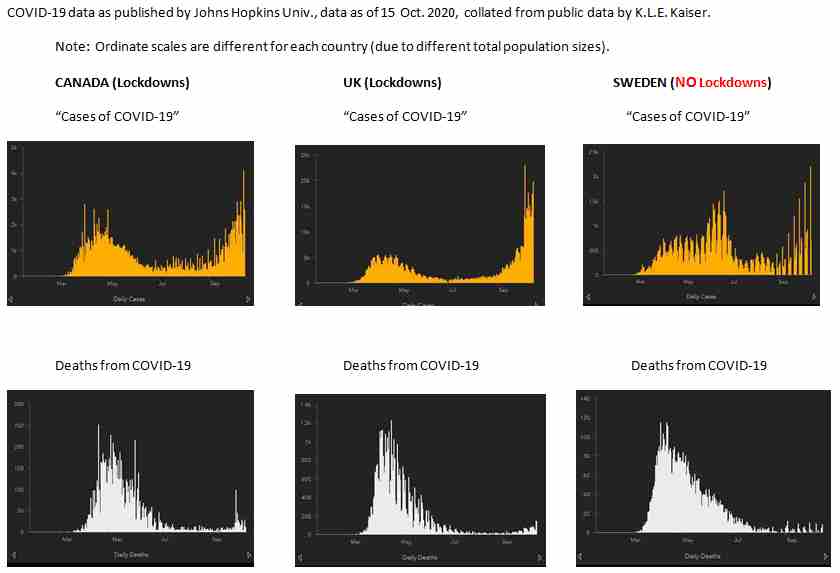
Covid-19 "Cases" vs. Deaths, as of Oct. 15, 2020, for Canada, the UK, and Sweden.
Have a look at the six graphs nearby, of the pairs (cases and deaths) for Canada, the UK (Britain), and Sweden. Each pair shows the number of cases and deaths. These are
official numbers collated daily by the Johns Hopkins University ( https://gisanddata.maps.arcgis.com/apps/opsdashboard/index.html#/bda7594740fd40299423467b48e9ecf6 ).
Anyone with a smidgen of intependent thinking ought to be able to interprete these graphs and realize how mistaken the current restictions are.
Slimy Creatures on the Way
A new disaster brewing?
Earthworms, like the common earthworm or dew worm (Lumbricus terrestris and related spp.), known to most people is considered an invasive species in parts of North America.
In fact, Wikipedia claims that one third of the earth worms found on the continent are invasive species that have been introduced in the 18th century and that they alter the leaf litter
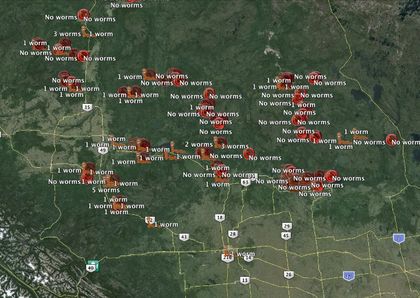
and soil composition through their activity. The Google science page says: "Alberta's earthworm invasion can be tracked with U of A app." The picture going along with the article
in the Edmonton Sun
provides the clue (if you really needed one):

Once you enlarge the picture (you can get it HERE) so to be able to read the embedded text you'll get it: There are more "No worm" sightings than those with "1 worm" or the maximum of "5 worms" or
its nearest neighbor of "3 worms" (count of each: 1). If you need a good laugh, then go to the University of Alberta website at http://worms.educ.ualberta.ca/ and download the app to count them worms.
It sure is interesting to note what is reported in Google's science news these days. [June 2015]
Putting the Cart before the Horse
The article in the Globe and Mail on "Climate change's costs hit the plate" [1] is a prime example of putting the cart before the horse.
Its author, T. Homer-Dixon, blames the current rise in corn prices on global warming.
No doubt the recent drought throughout much of the North American continent has decreased anticipated agricultural yields. Some farm fields
have shriveled away entirely, but why is a loss of-- say 10% of the average annual production of corn, such a problem that it causes prices
to double in short order?
The Al Gore Cause
Al Gore promoted the idea of "growing fuel", more specifically, planting more corn and converting it to ethanol for admixture to gasoline.
The idea was to produce less carbon dioxide (CO2) from fossil fuels and thereby mitigating global warming (supposedly caused by CO2). The U.S. and Canadian governments were willing listeners and enacted bio-ethanol mandates requiring initially a 5% and more recently a 10% bio-ethanol concentration in gasoline. The U.S. government is currently considering raising that level yet again to 15% bio-ethanol.
Where does this bio-ethanol come from?
Currently, on this continent, almost exclusively from corn!
Even with the current level of 10% bio-ethanol in the gasoline, an estimated 40% of the continent's corn production is being converted to
this automotive fuel additive! The idea of "cellulosic" bio-ethanol-- that is ethanol produced from products like corn stalks and husks is
just a technological pipe dream at this time.
Food Consequences
As a consequence of the corn-to-ethanol mandate, farmers planted corn in every nook and cranny possible. Previously fallow and marginal
fields were all planted with corn. However, that increased acreage could not possibly compensate for the diversion to fuel.
The corn-to-ethanol mandate essentially reduced the corn available for the traditional food and feed purposes to 60% of what was the norm.
Increasing the bio-ethanol level to 15% in fuel will only exacerbate the problem.
Automotive Consequences
The bio-ethanol mandate has automotive consequences as well, especially the planned increase to a level of 15% ethanol (E-85) in gasoline.
The reasons are technical and chemical.
Ethanol is a great solvent. Many materials (even aluminum metal components in car engines) are slowly dissolved by it. That is why car
manufacturers have warned that their existing warranties would become void if E-85 gasoline were to be used.
Energy Consequences
From a fuel-energy point of view, the ethanol mandate is doing just the opposite of what is being hoped for by the proponents of that idea.
Instead of reducing overall fuel consumption, it will increase it, by more than the percent level of ethanol. The reason is that ethanol,
chemically speaking, is already partially burnt gasoline. Therefore, if your vehicle requires a certain amount of horsepower to move your
load at a given speed and terrain, it will consume much more of E-85 type gasoline than gasoline free of ethanol.
Apart from all the negative consequences noted above, the original idea of reducing the need for crude oil imports by converting corn to
bio-ethanol for fuel is fatally flawed. A study by UC Berkeley geo-engineering professor Tad W. Patzek in 2005 [2] concluded that:
"Ethanol Production Consumes Six Units of Energy to Produce Just One"
As Alan Caruba noted in a recent post in Canada Free Press [3], "it takes a long time to rid the world of a really bad idea." The bio-ethanol
mandate is just one of those really bad ideas. It was based on faulty energy analysis, political grand-standing and environmental group-think.
Even Al Gore has recognized it as a bad idea [4].
As to Dr. Homer-Dixon's article, it requires a special globally-warmed-adaptive mind to blame the increased corn price solely on the current
hot and dry weather and totally forget the much larger impact of the diversion of this staple to fuel.
[1] http://www.theglobeandmail.com/commentary/climate-changes-costs-hit-the-plate/article4436775/
[2] http://www.sciencedaily.com/releases/2005/03/050329132436.htm
[3] http://www.canadafreepress.com/index.php/article/48277
[4] http://www.dailymail.co.uk/news/article-1332231/Al-Gores-U-turn-corn-ethanol-I-mistake.html
[July, 2012; published by CanadaFreePress on July 24, 2012, http://www.canadafreepress.com/index.php/article/48303]
_________________
Mann oh Mann!
The press release of the 2007 Nobel Peace Prize announcement reads "...to be shared, in two equal parts, between the Intergovernmental Panel on Climate Change (IPCC)
and ...(Al) Gore Jr." [link]
Further down in the Nobel Committee's announcement it says "Thousands of scientists and officials from over one hundred countries have collaborated ..." There is
no word of Michael E. Mann or any other individual's report, author or scientist whose work may have contributed in any way to the IPCC.
Who can claim to share the IPCC's Prize?
The question then arises: Can anyone whose work is referenced in any IPCC document or who has otherwise contributed to any IPCC report call him/herself
a "co-recipient" of that Nobel Peace Prize? Michael E. Mann seems to think so. His biographical sketch at the Pennsylvania State University web site says "He
shared the Nobel Peace Prize with other IPCC authors in 2007." [link]
If that were true, then what about the other "thousands of scientists and officials" who collaborated or contributed in any way to any IPCC report?
Can they all claim to share in the Prize too? Other than Michael Mann, other IPCC contributors don't seem to think so. Michael Mann appears to be the only one
of the 'thousands' asserting so in his bio.
Most likely at least some of the other scientists whose publications have been referenced in any of the IPCC documents may not even be aware of their work
having been cited. Other scientists may actually object to the claim of "having collaborated" on such reports. Are they all now Nobel Laureates too, unbeknownst to them?
Mann's Claim to Fame
Mann's claim to fame, it appears, is his work on the "hockey stick" graph (later shown to be faulty by McKitrick et al. [link]). Irrespective of the veracity
of Mann's hockey stick and related works, it would appear that Michael Mann, as a German idiom goes, "is decorating himself with other's feathers." [June 2012].
ADDENDUM [Nov. 2012]
After an unmistakably clear repudiation by The Norwegian Nobel Institute of Dr. Michael Mann's claim that he was a recipient of the 2007 Nobel Peace Price, Mann has quickly changed his tune.
Prior to Oct. 26, 2012, Mann's bio as published by the Pennsylvania State University, read "He shared the Nobel Peace Prize with other IPCC authors in 2007" as shown below.
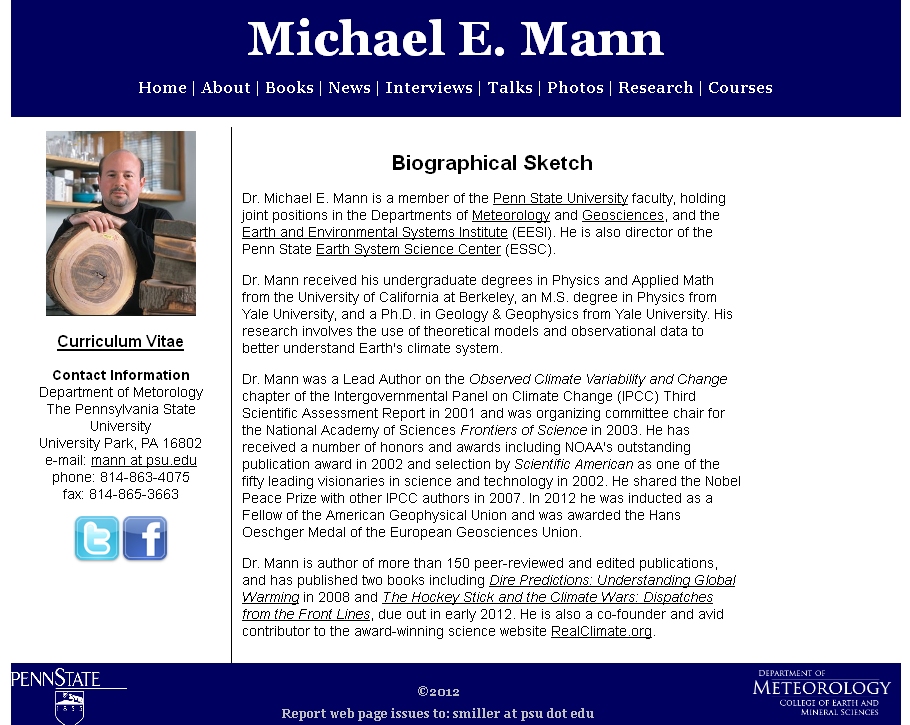
Following the revelation published by the Examiner on Oct. 26 [1], Mann's bio changed on Oct 27 to read "He contributed, with other IPCC authors, to the award of the 2007 Nobel Peace Prize." [2]
On cursory inspection, the revised version of Mann's contribution to the IPCC as claimed by him is barely different from the earlier one. However, the difference is fundamental and far
reaching. Mann is clearly just one of the thousands of perpetrators who have made the IPCC reports the clarion call for climate change. Perhaps, once the truth about the IPCC claims comes
to the fore as well, Mann may be happy about his newly-found status of "also ran."
[1] http://www.examiner.com/article/professor-mann-claims-to-win-nobel-prize-nobel-committee-says-he-has-not
[2] http://www.meteo.psu.edu/holocene/public_html/Mann/about/index.php
_________________
Santa is on the Run ...
... from climate change that is.
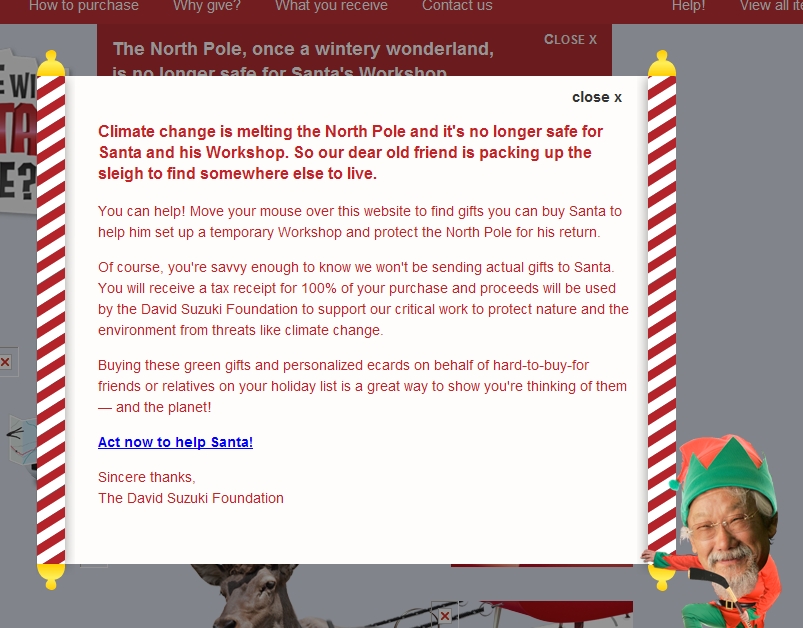
According to the David Suzuki Foundation, "Climate Change is melting the North Pole and it's no longer safe for Santa." But don’t despair, dear children,
just buy some virtual gifts from the Suzuki club, and they will help Santa to find a new place to live. See for yourselves:
As Johann Tetzel (1465-1519), appointed as Commissioner of Indulgences by Pope Leo X, proclaimed "Sobald das Geld im Kasten klingt, die Seele in den Himmel springt."
Translation: "When the coin in the coffer rings / the soul to heaven springs."
Of course, your gifts to the Suzukians are claimed to protect nature and the environment. At the very least, they ought to enable Tetzel’s reincarnation
to continue his jet-setting across the globe. [Canada Free Press; December 2011].
_________________
Climate Change and the Age of Wisdom
There are various "open letters" available on the internet, urging the political powers and executive boards of learned societies to adopt less
categorical stances with respect to "climate change" concerns and policies.
What do the letters have in common?
These open letters to societies and political leaders all have two characteristics in common:
(i) They are written by professionals who are well established in their careers, tenured academics, leaders of research groups, company executives,
recipients of many prestigious awards, all of whom enjoy a high national and international reputation.
(ii) Many of these professionals are retired or close to retirement. Therefore, they no longer need to kowtow to political, management, or peer
pressure to obtain research funds, etc. In other words, they can speak freely without fear of retribution.
The world's political leaders should heed their wisdom!
_________________
Consensus and Credibility
There appears to be a widespread perception as to the existence of "consensus" as a common principle in scientific discourse. More specifically,
the perception is that the view expressed by a majority of scientists on a particular question must be the correct one. Nothing could be further
from the truth, and there are plenty of examples throughout history which prove this wrong. From Galileo to Columbus, to Wegener, to Einstein,
and many others.
Anyone who develops new insights, based on experimental or theoretical considerations, is initially branded as a skeptic, heretic,
denier, etc. However, it is a fact that one lone voice can (over time) change the "consensus" of thousands. Therefore "consensus" does not prove
anything at all, nor the number of a scientist's publications, nor the number of citations a publication receives. Consensus is not a principle
of science. As the German philosopher Arthur Schopenhauer (1788-1860) observed:
All truth passes through three stages. First, it is ridiculed. Second, it is violently opposed. Third, it is accepted as being self-evident.
The reason for bringing this up is a paper published in June 2010 in the Proceedings of the National Academy of Sciences (PNAS), with the
title "Expert credibility in climate change." [Source: http://www.pnas.org ].
This particular paper, published by four authors, the last of whom is since deceased, analyzes, among other things, "the credibility of dissenting researchers"
by way of number of scientific papers published, number of citations in other papers, etc. In other words, it attempts to show a "credibility gap"
for the dissenting voices versus the "97-98% [of scientists] most actively publishing in the field support the tenets of anthropogenic climate change."
In my mind, this work is reminiscent of Lysenkoism. Frankly, I do not think that a submission of that kind would have ever been considered
for publication a decade or two ago by any reputable scientific journal. This paper tries to abrogate scientific discourse to the most common
denominator, or enumerator (number of publications, citations, etc.). While it is not clear whether or not this "contribution" to PNAS was
peer-reviewed or not, it should never have even been considered by that journal. Credibility and consensus do not make good science. [July 2010].
For other views on this subject, see, for example, comments by Joanne Nova at http://joannenova.com.au, or by Donna Laframboise at http://nofrakkingconsensus.blogspot.com, or by Rich Trzupek, FrontPage Magazine, at http://frontpagemag.com .
_________________
Faked 'consensus' ?
On June 26, 2010, John O'Sullivan, writing for Canada Free Press,
reported:
"New global warming data fraud scandal seems to show a faked
'consensus' of the impact of solar forcing on Earth's climate based on one
[only] finding.
A staggering new finding seems to mire the Intergovernmental Panel on Climate
Change (IPCC) in global warming scandal every bit as devastating as Climategate.
Apparently, objections were raised to the IPCC by the Norwegian Government
as early as the draft version in the preliminary phases of the IPCC's draft
of their Fourth Report of 2007, which won the organization the Nobel Peace
Prize.
A total of six further peer-reviewed papers were dismissed by the IPCC for
inclusion. At least one of the papers, by leading solar expert Hans Svensmark
totally contradicted the IPCC's conclusions that the Sun was not a key player
in climate change." [Source: http://canadafreepress.com].
More details on the above story, which has become known under the term "Judithgate", including copies of letters by some scientists, are
available at: http://climatechange.thinkaboutit.eu;
[June 2010].
_________________
Europe's Little Ice Age on its way back?
It was remembered throughout the British Isles (and much of Europe, too) as
the “great winter” of 1683-1684. In parts of England and Scotland, snow drifted
to heights of 20 feet. Animals and people perished from the cold. The frost, as
the freezing temperatures were called, lasted longer than it had ever lasted.
According to an interview with the British Broadcasting Corp., University of
Reading physicist Michael Lockwood asserted that Europe should expect unusually
cold winters for decades. [Source: Globe and Mail; http://www.theglobeandmail.com ]; [June 2010].
_________________
The Royal Society
In late May 2010, another nail hit the climate coffin. The Times
reported that:
"Britain's premier scientific institution is being forced to review its
statements on climate change after a rebellion by members who question
mankind's contribution to rising temperatures.
The Royal Society has appointed a panel to rewrite the 350-year-old
institution's official position on global warming. It will publish a
new "guide to the science of climate change" this summer. The society has
been accused by 43 of its Fellows of refusing to accept dissenting views on
climate change and exaggerating the degree of certainty that man-made
emissions are the main cause." [Source: The Times, http://www.timesonline.co.uk]; [June 2010].
Addendum: In September, 2010, the Royal Society released their revised guide on
"Climate change: a summary of the science". In it, it has significantly toned
down their previous statements about the science. For example, it nows says:
"There is very strong evidence to indicate that climate change has occurred on a wide
range of different timescales from decades to many millions of years; human activity is
a relatively recent addition to the list of potential causes of climate change."
_________________
Frogs
In recent years, i.e. from 2002 onwards, a decline of
amphibian species was reported from all over the globe. For
example, in 2002, K.Y. Masibay writing for Science World
described the observation of many dead frogs in Panama [Source:
http://findarticles.com
]. In 2006, J. Eilperin of the Washington Post wrote on
Frog species dying out - global warming blamed....
[Source: http://articles.sfgate.com
].
Almost everyone believed the initial claims as to the
perceived cause: global warming. Several years later, it turned
out that global warming had nothing to do with the demise of the
frogs. The real reason was a fungus, Batrachoytrium
dendrobatidis, which got spread worldwide from the use of
infected frogs of the South African clawed frog species
Xenopus laevis. That species is in widespread use for a
variety of biological and medical testing purposes, including
pregnancy testing. [May 2010].
_________________
Lizards
The true reason for the worldwide frog crisis had barely been
found, when a new crisis was observed - and as you, dear reader,
may not be surprised to hear - also claimed to be due to
"climate change". This time, it involved lizards.
To fill you in, in May 2010, a number of researchers from
several countries, including the USA, Mexico, France, Colombia,
Argentina, Chile, Spain, Brazil, Peru, Finland, Australia, and
South Africa, had an article published in the well-renowned
science magazine Science with the title Erosion of
lizard diversity by climate change and altered thermal
niches. This article was quickly picked up by many news media
and general magazines, such as Nature, National Geographic,
and Scientific American. In other words, it received
widespread attention and propagation. The following gives you the
exact abstract of the article [Source:
http://www.sciencemag.org
].
It is predicted that climate change will cause
species extinctions and distributional shifts in coming decades,
but data to validate these predictions are relatively scarce.
Here, we compare recent and historical surveys for 48 Mexican
lizard species at 200 sites. Since 1975, 12% of local populations
have gone extinct. We verified physiological models of extinction
risk with observed local extinctions and extended projections
worldwide. Since 1975, we estimate that 4% of local populations
have gone extinct worldwide, but by 2080 local extinctions are
projected to reach 39% worldwide, and species extinctions may
reach 20%. Global extinction projections were validated with
local extinctions observed from 1975 to 2009 for regional biota
on four other continents, suggesting that lizards have already
crossed a threshold for extinctions caused by climate change.
So, I ask, what is wrong here? Now let me answer:
First of all, the field observations cover several decades
into the past. Secondly, the paper makes projections well into
the future. Really, nothing wrong with either one. But here comes
the dinger: Why blame it on climate change, or global
warming?
Not only are the presented statistical correlations of lizard
disappearance with temperature very poor to begin with, they also
suffer from a few highly influential data points, another flaw.
In any event, if the projections about the lizards were to come
true, would they not be in any way related to the rapidly expanding
populations in these countries, with the appurtenant increase in
agricultural land use, such as plowing-under, fertilizing, "biociding",
irrigating, and otherwise destroying the natural habitat for these
species?
Frankly, I find it almost sickening these days that nearly
everything under the sun needs to be blamed on "climate
change" and the like. This kind of speculation is not to the
benefit of mankind nor nature, as it diverts from the real
culprit, namely the burgeoning human population and its
concurrent need to change the natural habitat in order to feed
itself. A much more plausible explanation would be the population
growth in general and the increased area of land used for
agriculture during the periods of survey and projection. For
example, Mexico's population has nearly doubled since 1975
and so has its agricultural land. Much of that land is prime
habitat for lizards; [May/June 2010].
Habitat destruction and direct killing are the
major causes of species decline, throughout our history and
evolution, not the perceived "climate change".
|